Each December, bait goes out at a dozen spots across Town and Country, mostly in backyards with the owners' consent. A few weeks later, sharpshooters from White Buffalo, Inc. sit at those spots and wait for a northwest wind. In the 2024 to 2025 season, pre-baiting ran from December 12 to January 2. Shooting ran from January 3 to January 14, and one night was called off for blizzard conditions. The crew harvested 79 deer over 11 field days.
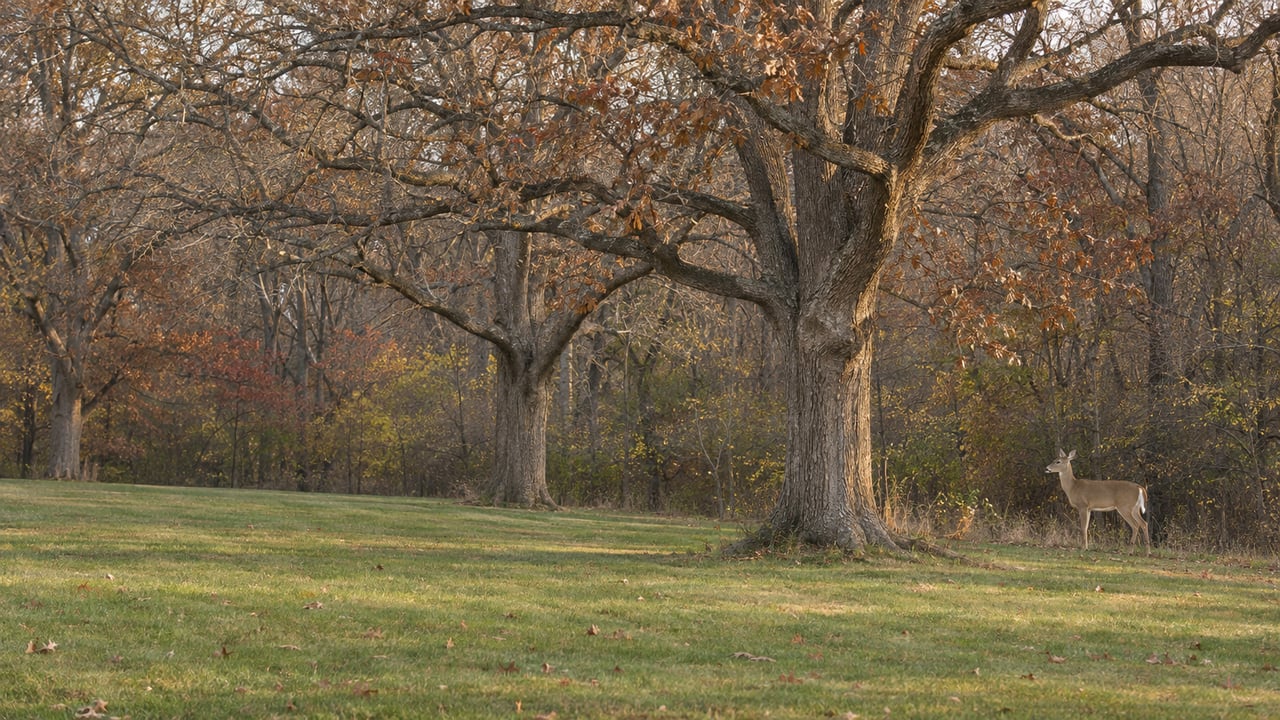
The city's final report on that season calls it the 15th year of the program. It also gives the best current picture of the deer you pass on Mason Road at dusk. There are far fewer of them than there used to be, and they are no longer spread evenly through the city. Their age mix has shifted too. For anyone driving through west St. Louis County this week, the more useful number is the one from the roads.
Fifteen Winters, Measured
Town and Country hired White Buffalo, a nonprofit, for annual sharpshooting starting in 2009. St. Louis Public Radio reported in January 2015 that the contractor had culled 700 deer by then, based on figures from the city administrator at the time. The city also tried fertility control first. White Buffalo's own records show 100 does were captured and surgically sterilized in December 2009 and 30 more in December 2010. STLPR reported that the city stopped the sterilization work after those 130 does.
The question of sterilization came back on January 20, 2026, when the Board of Aldermen held a special work session devoted to deer management. According to a Citizen Portal summary of the session, White Buffalo's Ryan Rodts told the board that sterilization is impractical in Town and Country. He said the darts have to be fired from 15 to 20 feet, which doesn't work on lots this size.
At the same session, White Buffalo presented its main result. It estimated the city's density at about 12 to 15 deer per square mile, against roughly 60 per square mile when the program began. The contractor added that with sampling numbers that low, the city could feasibly take a year off from active removal.
The Herd Moved Toward Queeny Park
A density of 12 to 15 deer per square mile is a citywide average. Few streets actually see that number. White Buffalo's January 2026 presentation put most of the remaining deer near Queeny Park.
The 2025 harvest by ward points the same way. Of the 79 deer taken in January 2025, Ward 2 accounted for 37, Ward 4 for 26, Ward 3 for 15, and Ward 1 for just one. Half of the active sites were in Ward 2. The single best site was in Ward 3 and produced 16.5 percent of the total. The report also names two places where the crew wanted access and didn't have it: the eastern edge of Queeny Park and the area along Topping Road. Both were chosen for the number of deer the crew generally sees there.
This pattern goes back years. White Buffalo's January 2014 report recorded deer sightings along Mason Road by Queeny Park. It also suggested that recreational feeding near Brook Mill might be linked to the deer-vehicle collisions there.
Queeny Park has its own count as well. St. Louis County's park has hosted an archery hunt since the 2020 to 2021 season. Hunters there removed 30 deer in 2020, 37 in 2021, 27 in 2022, 22 in 2023 and 18 in 2024. At the January 2026 work session, City Administrator Bob Shelton put the 2025 Queeny figure at 16. MDC's managed-hunt list for 2026 to 2027 scheduled Queeny Park Hunt 66 for 30 archers from October 19 to November 13.
So the Queeny archery harvest has fallen by about half since 2021, even though Queeny is now where most of the deer are.
A Younger, More Male Herd, With Coyotes Around It
The 2025 report includes three observations that White Buffalo calls notable.
Coyotes lead the list, a subject the contractor first raised in its 2023 report. By January 2025, coyotes were seen or caught on game cameras at every site, sometimes several at once and sometimes in daylight.
Fawns were scarce. White Buffalo would expect juveniles to make up about 40 percent of a harvest. In January 2025 they were about 14 percent, the third straight year below average. Of the 79 deer, 11 were fawns.
Young bucks went the other way. Yearling males usually make up about 10 percent of the harvest. In 2025 they made up 31.5 percent, nearly three times the usual share. Males were 43 of the 79 deer overall.
Effort per deer has crept up too. The crew logged 215 person-hours for the 79 deer, or 2.72 hours per deer, compared with 2.57 the year before. Two years earlier, in January 2023, the program took 50 deer over seven field days.
The Count That Comes From the Roads
When Shelton went through the 2025 season for the aldermen, he listed the removals beyond the sharpshooting. Animal Care Services removed 14 deer and the Queeny Park hunt removed 16, while vehicles hit 44, more deer than the bowhunt and Animal Care Services removed together.
Older figures use a different measure, so the two don't line up directly. STLPR's 2015 story cited 97 deer-vehicle collisions in Town and Country in 2012 and 74 in 2014, a 24 percent drop over those two years. The 2025 figure counts deer struck rather than collisions. Even so, cars and deer still meet on Town and Country roads dozens of times a year, at roughly a quarter of the density the program started with.
The time of year matters. The Missouri Department of Conservation puts the peak of the white-tailed deer breeding season in mid-November, and Thanksgiving week comes right after it. With the herd concentrated around Queeny Park and young males making up a larger share, the stretches of Mason Road and Topping Road near the park are where the contractor's maps and notes point. Those are the stretches to drive slowly at dawn and dusk this month.
The Garden Side of a Smaller Herd
Fewer deer per square mile doesn't mean a hosta bed near the woods is safe, especially on the Queeny Park side of the city. The Missouri Botanical Garden's deer guidance says "deer-resistant" plants are ones deer tend to pass over, not plants they won't eat. When deer are hungry or crowded, they will eat almost anything. The Garden recommends a long-term, phased plan and suggests keeping the plants you care most about away from woodland edges.
The Garden's list of plants deer don't favor includes three that already define many Town and Country front yards: boxwood, redbud and daffodil. Clipped boxwood along the foundation, a redbud at the corner of the drive and daffodils along the lawn edge make a planting plan that both looks right on these streets and holds up well against deer.
Where the Venison Goes
The program also feeds people. After the January 2025 season, John's Butcher Shop processed 74 deer into 3,700 pounds of meat, which was donated to Operation Food Search. Five more deer went to the Saint Louis Zoo's American Red Wolf Conservation and Recovery Facility, with permission from the Missouri Department of Conservation. Two years earlier, the January 2023 season sent 15 carcasses to the same Zoo facility, with John's Butcher Shop again handling the charitable processing.
The report's acknowledgments list the people who made the season possible: Shelton, the Town and Country Police Department, Erin Shank of MDC, John's Butcher Shop and "all the cooperating homeowners." The sites are in private yards, so the program depends on residents letting the crew in. Its next steps do too: the access White Buffalo said it lacked is along Topping Road and the eastern edge of Queeny Park.
For more about daily life here, see our Town and Country neighborhood page and our look at the 30-acre city park where much of the community calendar happens.
If deer have worked over a foundation planting or a woodland-edge garden at a home you're thinking of selling in Town and Country, getting the landscaping back in shape is one of the projects The Benes Group coordinates through our concierge service. Request a Complimentary Home Valuation, and we'll show you where the yard stands next to the homes buyers are comparing it with.